David and Mephibosheth: Kindness and Restoration
Faith, David And Mephibosheth, Kindness In The Bible, Restoration And Healing
David And Mephibosheth: When Kindness Comes Looking For You In Lo-debar
Somewhere between the throne room and the forgotten town called Lo-debar, a story unfolds that refuses to stay on the ancient page. It is a story about a king who goes looking for someone to be kind to, a broken heir who calls himself a dead dog, and a table where restoration and healing do not erase the limp, but quietly dethrone its power. Ministry Prayer Life holds this story close, because it speaks directly into the places where many of us live—out of sight, out of confidence, and convinced that our damage has the final word on our worth.
A King Who Went Looking For Someone To Be Kind To
Second Samuel 9 does not open with a crisis; it opens with a question. David, now firmly established as king, asks, “Is there anyone still left of the house of Saul to whom I can show kindness for Jonathan’s sake?” The Hebrew word for kindness here is hesed—covenant kindness, loyal love, mercy that keeps its promises even when memories fade and politics move on. This is not damage control, not public relations. This is a king whose heart leans outward, searching: Who can I be kind to?
For many of us, Kindness In The Bible feels conditional. We expect it to show up when we earn it, when we are strong, when we are useful. But David’s question begins in the opposite direction. He is not asking, “Who deserves this?” He is asking, “Who remains? Who is left?” The kindness is not drawn out by the recipient’s performance. It is drawn out by a promise he once made to Jonathan, by love remembered, by loyalty that outlives the one it was first given to. Kindness goes looking, even when you are not calling for it.
The Forgotten Heir In A Place Called “No Pasture”
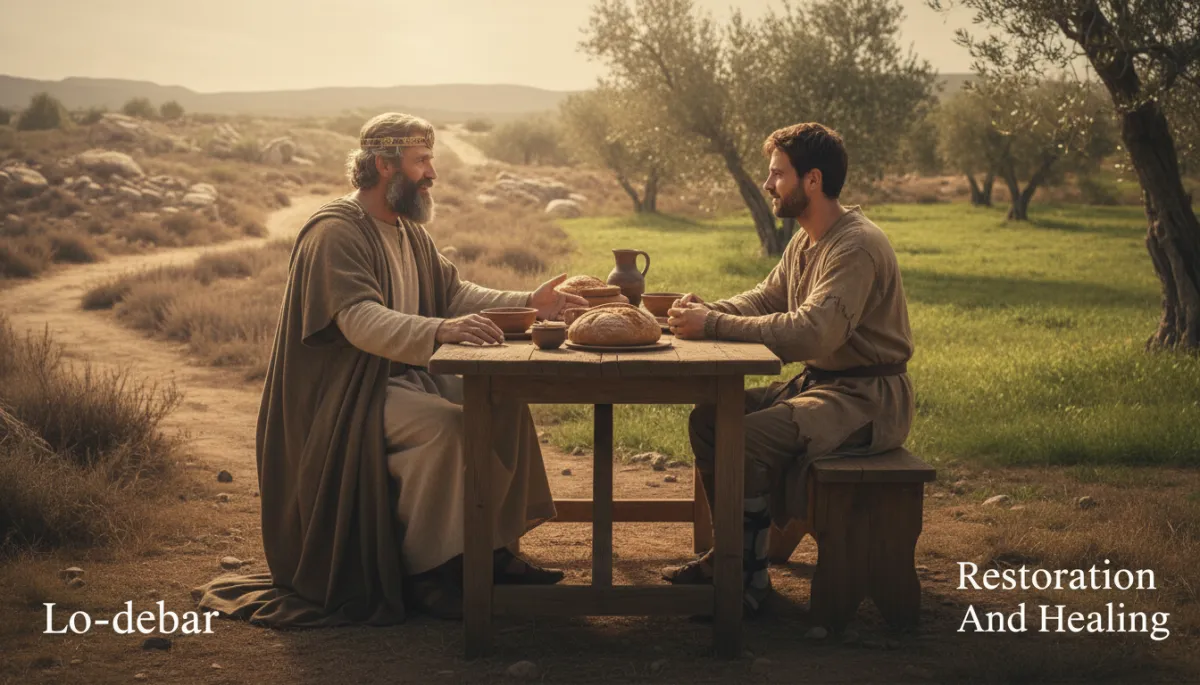
The search turns up a name: Mephibosheth, Jonathan’s son, Saul’s grandson. A royal heir—but the text introduces him with a wound before it calls him to the palace. He is lame in both feet. He is living far from Jerusalem, in a town called Lo-debar. The Lo-debar meaning is stark: “no pasture,” “no word,” “no place of growth.” It is the kind of name you give to a region you do not expect much from, a place for hiding, surviving, not flourishing.
Mephibosheth is a forgotten heir in a forgotten town. He has royal blood, but a wilderness address. Many who call our prayer line at Ministry Prayer Life know this feeling in their bones. You may carry promises you once believed God spoke over your life, but your current location feels like Lo-debar—dry, unremarkable, not what you imagined. Your story has a title, but your days feel like “no pasture,” no fresh word, no open doors.

Lo-debar echoes the dry seasons where promise and present reality feel worlds apart.
An Injury At Five: Wounds You Did Not Choose
Scripture rewinds Mephibosheth’s story to a moment when he was just five years old. News came that Saul and Jonathan were dead. Panic swept the household. His nurse picked him up and fled. In the chaos, he fell and became lame. The rest of his life would be shaped by an injury sustained at five while someone else fled. He did not cause the danger. He did not choose the response. But he lived with the consequences in his own body every day afterward.
Some of your deepest wounds carry a similar pattern. Decisions other people made in fear, in anger, in confusion, collided with your small and vulnerable life. The fallout settled into your nervous system, your relationships, your sense of safety. Self-worth In Scripture often grows in soil that has known this kind of storm. The Bible does not pretend that your limp is imaginary. It writes it into the narrative, right next to your name, and then dares to say: this is not the end of the story.
“A Dead Dog”: When Self-Assessment Hardens Into Fact
When Mephibosheth finally stands—perhaps leans, perhaps is helped—before David, his first words are soaked in fear: “What is your servant, that you should notice a dead dog like me?” This is more than a passing insult. It is a self-description stated as settled fact. He does not say, “I feel like” a dead dog. He declares, “I am” one. Worthless. Unclean. Disposable. Beneath notice, and certainly beneath kindness.
Many of us have internal sentences like this. They may not be as stark, but they carry the same weight: “I am too broken. I am a burden. I am beyond repair.” Over time, they calcify. They become the lens through which we read every look, every silence, every unanswered prayer. Yet Self-worth In Scripture is rarely rebuilt by arguing with those sentences. Instead, God often responds the way David does—by changing where you sit rather than debating what you call yourself.

God often answers shame not with arguments, but with a changed place at the table.
Why David Does Not Argue—He Sets A Place Instead
Notice what David does not say. He does not rush to correct Mephibosheth’s language. There is no recorded, “Don’t talk about yourself like that,” no pep talk, no quick fix to his self-esteem. Instead, David moves straight to action: he restores Saul’s land to Mephibosheth and, more intimately, commands that he will always eat at the king’s table as one of the king’s sons. David seats him at the table instead of arguing with his self-assessment.
This is how Restoration And Healing often arrive. Not as a tidy refutation of every lie you have believed, but as a new lived reality that slowly makes those lies harder to sustain. You may still whisper, “I am a dead dog,” but your chair is at the table. Your meals are with the royal family. Your days are no longer scheduled by Lo-debar’s silence but by the rhythms of the king’s house. At Ministry Prayer Life, we pray not just for changed feelings, but for changed places—relationships, communities, and inner postures where the table of grace becomes your new normal.
Kindness For Someone Else’s Sake—And Still For You
David’s kindness has a specific anchor: “for Jonathan’s sake.” This is not favoritism. It is covenant. Long before Mephibosheth limped into the throne room, David and Jonathan had made a vow before God. Their friendship carried a promise that outlived war, betrayal, and death. The kindness came for someone else’s sake, but it landed on Mephibosheth’s life like rain on cracked ground.
This is one of the profound Biblical Lessons On Grace. You are drawn into favor you did not earn because of a covenant made before you could respond. In Christ, the Father’s kindness toward you is anchored in the Son’s obedience, the Son’s sacrifice, the Son’s love. You may feel like a dead dog; the covenant says “beloved.” You may live in Lo-debar; the covenant says “prepared place.” Grace comes for Jesus’ sake—and yet it really comes to you. It finds you where you are hiding and calls you by name.
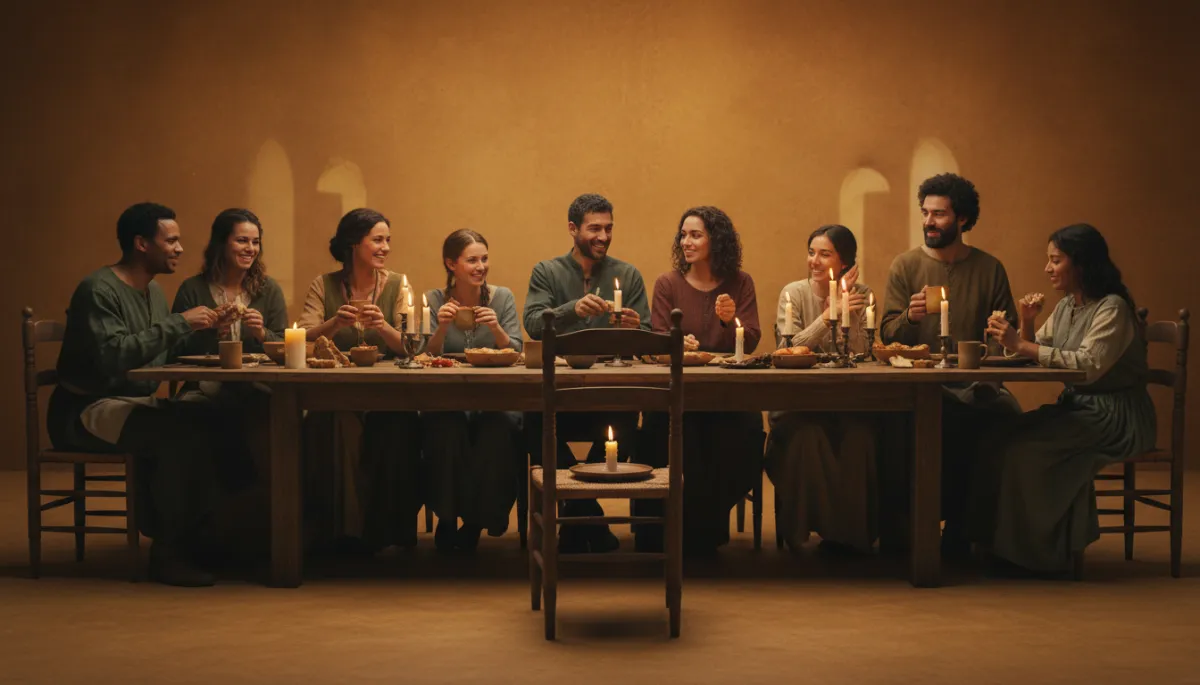
Grace reserves a chair for you because of a covenant older than your fear.
“He Was Lame In Both Feet”: The Limp That Stayed
The chapter closes with a quiet, deliberate repetition: Mephibosheth lived in Jerusalem, ate at the king’s table always, and “he was lame in both feet.” It is as if the narrator wants to be sure we do not misunderstand what has happened. This is restoration that doesn’t undo the damage but stops it deciding where you sit. The limp remains. The shame narrative does not. The injury is real. Its authority is revoked.
Why does the chapter deliberately end by repeating that he was still lame? Because the Bible is not interested in fairy tales where pain vanishes without a trace. It is telling the truth about grace. Restoration And Healing in God’s kingdom do not always mean erasure of scars, memories, or limitations. Sometimes they mean that the very things that once disqualified you are now carried, openly, to the table of belonging. Your limp travels with you, but it no longer chooses the room you enter or the name you answer to.

The limp remains, but the seat at the table says the story has changed.
When Lo-debar Is Your Address And “Dead Dog” Your Name
You may be reading this from your own version of Lo-debar—a hospital room, a quiet apartment, a late-night shift, a relationship that feels more absence than presence. You may carry an inner script that sounds a lot like Mephibosheth’s: “Why would God notice someone like me?” The story of David And Mephibosheth does not rush you past that feeling. It names it. It honors the history that produced it: the fall at five, the years in hiding, the long echo of other people’s choices.
But it also insists on this: there is a King whose kindness goes looking, even now. There is a covenant stronger than your conclusions about yourself. There is a table where your limp is not a liability but a testimony. Your story may not circle back to erase the moment you fell. Yet grace can step into that story and quietly, steadily, move you from “no pasture” to shared bread, from “dead dog” to “beloved guest.”
📌 Key Takeaway: In God’s economy, healing is not always the absence of weakness, but the re-location of weakness into a place of honor, safety, and shared life at His table.
Sitting With You At The Table: A Pastoral Invitation
At Ministry Prayer Life, we carry this chapter in our prayers for you. When you call, when you submit a request in the middle of the night, we remember a king who went looking for someone to be kind to. We remember a forgotten heir in a town named “no pasture.” We remember that Kindness In The Bible does not wait for you to walk without a limp before it pulls out a chair. We remember that Biblical Lessons On Grace are not abstract; they are invitations to sit, to breathe, to belong even while you still feel broken.
If you find yourself in Lo-debar today, you do not have to stay there alone. Our 24/7 prayer line exists to step into that quiet with you, to speak blessing over the places that feel like “no pasture,” and to ask God to lead you, slowly and tenderly, toward His table. You can call, share your story, or simply let someone speak your name before the King who remembers His covenant. You can volunteer, pray with others, or support this work so that more Mephibosheths can hear that they are wanted, even with their limp.
The injury may remain. The brace may stay. But in Christ, it no longer decides where you sit. There is a place set for you, not because you are strong enough, but because the King has decided to be kind—for Jesus’ sake, and for yours. When you are ready, come sit. And if you need someone to walk with you from Lo-debar to the doorway of that hall, Ministry Prayer Life will walk, and wait, and pray beside you.