Mark 5: Chains, Control & Redeemed History
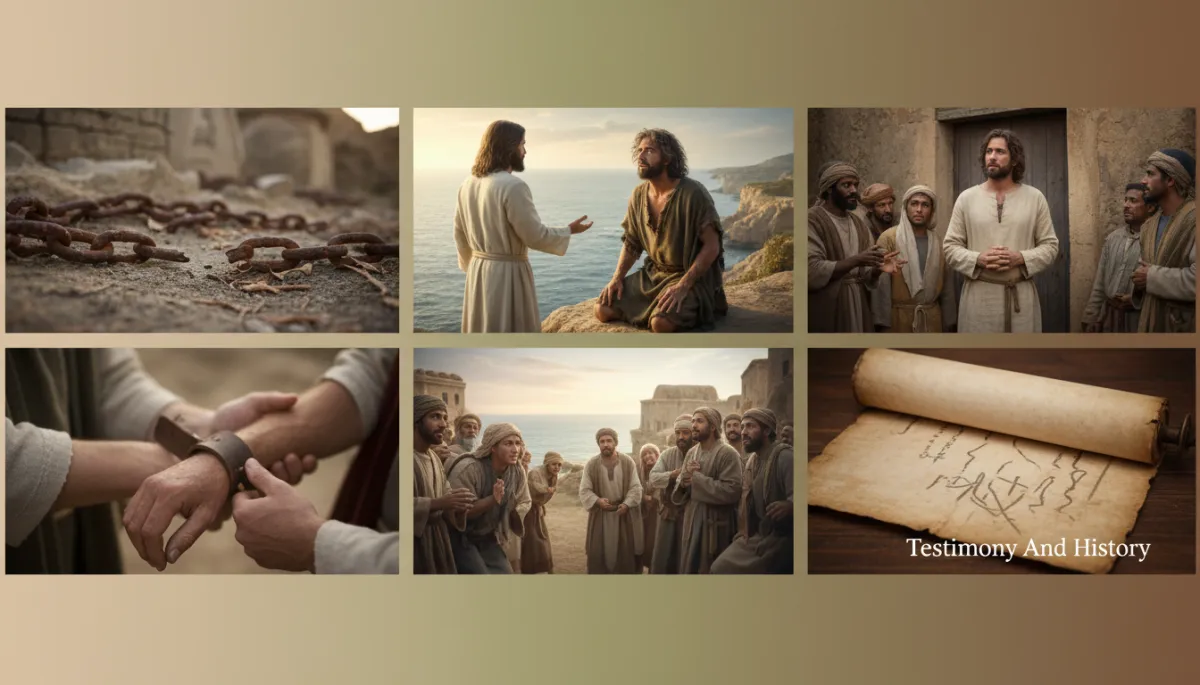
Mark 5 Teaching, Man Among Tombs, Chains And Control, Jesus Asks Name, Townspeople Reaction, Testimony And History
Mark 5 and the Man Among the Tombs: Chains, Control, and a Redeemed History
As a senior software developer, I spend my days thinking about systems, edge cases, and what we do when something or someone no longer behaves as expected. Mark 5’s story of the man among the tombs reads, in many ways, like a case study in how a community handles “unhandled exceptions” in real life—and how Jesus steps in with a completely different architecture of mercy, authority, and restoration. At Ministry Prayer Life, we see versions of this story every day on the prayer line: people others have tried to help, then control, then contain, and finally abandon. Mark 5 Teaching gives us a framework for seeing them—and ourselves—through Jesus’ eyes.
From Helping, to Controlling, to Containing, to Leaving
In Mark 5, the Man Among Tombs begins as someone from the community. He had a home, relationships, and a story before he became “that guy out by the graves.” Scripture tells us he lived among the tombs, cried out night and day, and cut himself with stones. The text also notes that people had often bound him with shackles and chains, but he tore them apart. Eventually, he is isolated outside town—contained at the margins, where his suffering won’t interrupt anyone’s daily routines.
This is a familiar pattern in human communities, and it mirrors how we handle failing systems in tech:
Helping: At first, people likely tried to care for him, support his family, and bring him back into normal rhythms. Think of this like compassionate debugging—sitting with the problem, trying to understand it.
Controlling: As his behavior became more dangerous, they shifted from care to control—imposing rules, restrictions, and perhaps religious or social pressure, hoping he would “just behave.” This is like adding more and more validation checks and guards around unstable code.
Containing: When control failed, they resorted to Chains And Control—literal shackles. This is containment: putting a failing service behind strict firewalls so it can’t hurt the rest of the system, even if it means the service itself is now isolated and broken.
Leaving: Finally, when even chains could not hold him, they left him where he was—among the tombs, naked, screaming, self-harming. At that point, the community had accepted his suffering as “just how it is.”
💡 Reflection: Many who call Ministry Prayer Life are at this “tombs” stage—others have tried, failed, and walked away. The gospel insists that this is not the end of their story.
Why the Chains Were Reasonable, Not Cruel
It’s easy, from a distance, to judge the townspeople. But Mark’s narrative hints that the chains were not primarily about punishment; they were a desperate attempt to protect both the man and the community. He was hurting himself and was strong enough to break restraints. If you’ve ever worked on a production system that can do real harm—a financial engine, medical software, safety-critical control—you know that guardrails are not cruelty; they are mercy in a broken environment.
In that sense, the chains were “reasonable.” They were the best solution they knew, given their limited tools and understanding of what was tormenting him. They saw a human problem and applied human fixes: rules, force, distance. What they could not see was that they were dealing with something spiritual and systemic—“unclean spirits” that no human chain could bind. They had reached the limits of their architecture.

Human restraints failed where only the authority of Christ could truly free.
Why Jesus Asks His Name—and Why the Answer Is Plural
When Jesus arrives, He does not start with chains, commands, or containment. He starts with a question: “What is your name?” This might be the most tender line in the whole passage. In a world that defined this man by his behavior—“the demoniac,” “the crazy one”—Jesus addresses him as a person, not a problem ticket. He initiates relationship before resolution.
But the answer is chilling: “My name is Legion, for we are many.” The response comes back in the plural. This is more than one issue, more than one wound, more than one force at work. If I put it in code, the man’s internal state looks less like a single string and more like a complex, corrupted collection:
class TormentedMan:
    def __init__(self):
        self.name = None
        self.afflictions = []

    def identify(self):
        if len(self.afflictions) == 0:
            return self.name
        return f"Legion ({len(self.afflictions)} issues)"

man = TormentedMan()
man.name = "Unknown"
man.afflictions = ["trauma", "shame", "isolation", "spiritual_oppression"]

print(man.identify())  # Legion (4 issues)
Many who reach out to Ministry Prayer Life describe something similar. They don’t feel like a single, coherent self; they feel like “we are many”—a tangle of fears, addictions, memories, and spiritual battles. Jesus Asks Name not because He lacks information, but because naming exposes what’s really going on and re-centers the person in front of Him. The plural answer shows the depth of the problem, but it also highlights Jesus’ capacity: even a legion is no match for His authority.
📌 Key Takeaway: Jesus’ question restores dignity before deliverance. He treats the man as a “who,” not a “what.”
Why the Townspeople Reaction Was Fear, Not Joy
After the demons are cast into the pigs and the herd rushes into the sea, the townspeople come out and see the man “sitting there, clothed and in his right mind.” This should be the moment of celebration. Instead, Mark 5 Teaching says, “they were afraid,” and they beg Jesus to leave their region. Why?
Loss of control: They had grown used to a world where this man was predictable in his brokenness. Jesus disrupted their fragile equilibrium. A power that can do what their Chains And Control could not is a power they cannot manage.
Economic cost: The pigs represented real money. Their system took a hit. When grace starts to touch our economics, our schedules, our comfort, it can feel threatening rather than comforting.
Mirror held up: The healed man is living proof that they had settled for less than God’s heart. His restoration exposes their resignation. That’s uncomfortable.

Sometimes healing threatens the systems that grew comfortable with our brokenness.
In tech terms, Jesus has just deployed a completely new service into their environment—one that bypasses their old security model and does what no one thought possible. Instead of rejoicing, they mark it as a breaking change and roll it back by asking Him to leave. The Townspeople Reaction warns us: we can be more attached to predictable pain than to disruptive healing.
Why Jesus Refused to Let Him Leave in the Boat
The healed man does what many of us would do: he begs to go with Jesus, to get into the boat and leave behind the place of his shame. But Jesus says no. Instead, He gives him a specific commission: “Go home to your friends and tell them how much the Lord has done for you, and how he has had mercy on you.”
From a developer’s mindset, the man wants to decommission the old environment entirely. Jesus, however, wants to redeploy him into the same context as a living testimony. The boat represents escape; Jesus offers mission. This is deeply consistent with what we see at Ministry Prayer Life: people long to flee their history, but often God sends them back into familiar spaces as carriers of hope.

Jesus sends the healed man back as a witness, not as a prisoner.
When History Becomes the Only Credential His Testimony Needs
Notice what Jesus doesn’t do. He doesn’t send the man to seminary, require years of training, or insist on a spotless record. His only credential is his history: “the man who had had the legion.” The very story that disqualified him in the eyes of his neighbors becomes the foundation of his authority to speak about mercy. His Testimony And History are inseparable.
If we modeled this in code, his “resume” might look something like this:
testimony = {
    "past_state": "man_among_tombs",
    "present_state": "clothed_and_in_right_mind",
    "cause": "mercy_of_Jesus",
}

def share_story(context):
    message = (
        f"You knew me as {testimony['past_state']}. "
        f"Now you see me {testimony['present_state']}. "
        f"This change is because of the {testimony['cause']}."
    )
    context.broadcast(message)

# The man shares his story in the Decapolis
share_story(context=town_square)
That’s the heart of gospel witness: “You knew what I was; now you see what I am; the difference is Jesus.” In the Decapolis, people didn’t need a theological treatise. They needed to see a man they once chained now walking in freedom. His life became a living API endpoint, so to speak, for the mercy of God—simple, accessible, undeniable.
💬 Encouragement: If you feel disqualified by your past, remember: in God’s hands, your history is not wasted; it becomes your credential to speak hope to others.

The man’s transformed life preached a sermon no one in his town could ignore.
Bringing Mark 5 Into Our Prayer and Our Practice
For those of us who follow Jesus and work with systems—technical or human—Mark 5 Teaching is both a warning and an invitation. It warns us not to confuse containment with healing, or control with care. It invites us to see every “man among the tombs” in our lives—the family member, coworker, or even the part of ourselves we’ve given up on—as someone Jesus can still reach, name, and restore.
At Ministry Prayer Life, we want to stand where Jesus stands in this story: not on the hillside at a safe distance, but right on the shore, meeting people in the place everyone else has learned to avoid. We listen, we pray, we speak the name of Jesus into situations that feel like “Legion.” And we trust that the same Christ who broke those ancient chains is still able to bring people into their right mind today.
If you or someone you love feels “chained” by fear, addiction, shame, or spiritual oppression, you don’t have to stay among the tombs. Call our 24/7 prayer line, submit a prayer request online, volunteer with us, or support this work through a donation. Together, we can make space for stories like this man’s—stories where history becomes the very credential God uses to bring hope to others.