Midnight in the Philippian Jail: A Community Lesson
Faith-Based Ministry, Nonprofits, Community Outreach, Incarceration
Midnight in the Philippian Jail: A Teaching for Communities Who Dare to Listen
Acts 16 tells a midnight story most of us think we know: a prison, an earthquake, chains falling, a jailer on his knees. But before the shaking and the spectacle, there is a quiet line that nonprofits, churches, and community leaders cannot afford to skip: “and the prisoners were listening to them.” For those of us who have spent years inside facilities, that one sentence changes everything about how we read the scene, and how we understand our own work among people who feel locked in by bars, by systems, or by stories that have already been written about them.
“And the Prisoners Were Listening”: The Sentence We Skip
In Acts 16:25, Luke writes, “About midnight Paul and Silas were praying and singing hymns to God, and the prisoners were listening to them.” We tend to rush past that clause, eager to get to the earthquake, the miracle, the dramatic conversion. But in any jail or prison, those few words describe the most believable part of the story. Of course the other prisoners were listening. There is nothing else to do at midnight in a cellblock when sound carries farther than light. Every conversation becomes public. Every song becomes a broadcast. Every prayer becomes a kind of announcement: someone in here still believes there is more than this.
For nonprofits and ministries that serve in correctional facilities or in communities that feel just as confined, this is the starting point: you are heard long before you are believed, and you are believed long before anyone ever says so out loud. The men and women you serve are listening from the edges, from the next bunk, from the back row of the chapel, from the last seat in your support group. They may seem uninterested, but in places like this, listening is survival. They are listening to see if your hope can survive the night shift.
📌 Key Takeaway: Before any visible miracle, there is a hidden audience. Your faithfulness is already on the loudspeaker, whether or not you have a microphone.
Why There Is No Private Witness in a Place Like That
In a jail, privacy is a rumor. Metal bunks, concrete floors, and steel doors turn each word into an echo. You hear arguments two cells down, whispered negotiations, muffled sobs. You learn who just got bad news, who is waiting for a court date, who hasn’t had a visit in months. The walls that keep people in do not keep sound from traveling. That’s why there is no such thing as a purely personal faith expression inside. Every act of trust, every moment of despair, every outburst of rage becomes part of the shared story of the tier.
Paul and Silas are not leading a scheduled worship service. They are not using a chapel or a sound system. They are bruised, bleeding, and locked in the inner cell. Yet their decision to pray and sing is public by default. It is overheard, weighed, and tested by men who know pain, injustice, and boredom more intimately than most congregations ever will. Their witness is not a sermon; it is the sound of two wounded men refusing to let the dungeon decide what God is allowed to sound like at midnight.
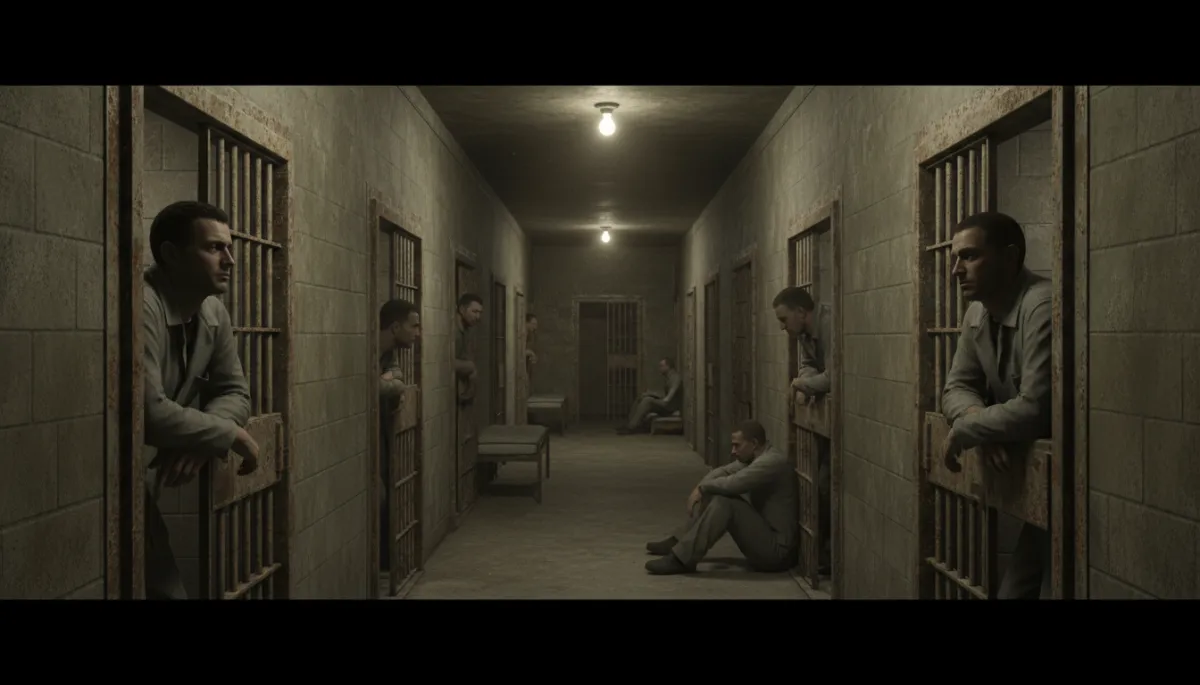
In confined spaces, every act of faith becomes a shared story, never a secret.
For nonprofits and communities, this means that your presence is never neutral. Staff conversations, volunteer attitudes, the way you leave a room, the way you say goodbye to someone in handcuffs — all of it speaks. The work of Ministry Prayer Life has taught us that even a whispered prayer in a hallway can become a lifeline, because someone three doors away is measuring whether this faith is safe enough to approach. In carceral spaces and in neighborhoods that feel just as watched, you don’t get to choose whether you’re a witness; you only choose what kind of witness you will be.
Worship at Midnight: A Decision, Not an Emotion
Midnight is more than a time on the clock. It is the hour when options feel thin and stories feel finished. In facilities, midnight is when the noise quiets and the mind gets loud. Regrets arrive. Fears pace the floor. The future shrinks to the size of a cell. In that hour, worship is not a natural response. It is not a mood. It is not the overflow of a good day. It is a deliberate act of defiance against the conclusion that this is all there is and all there will ever be.
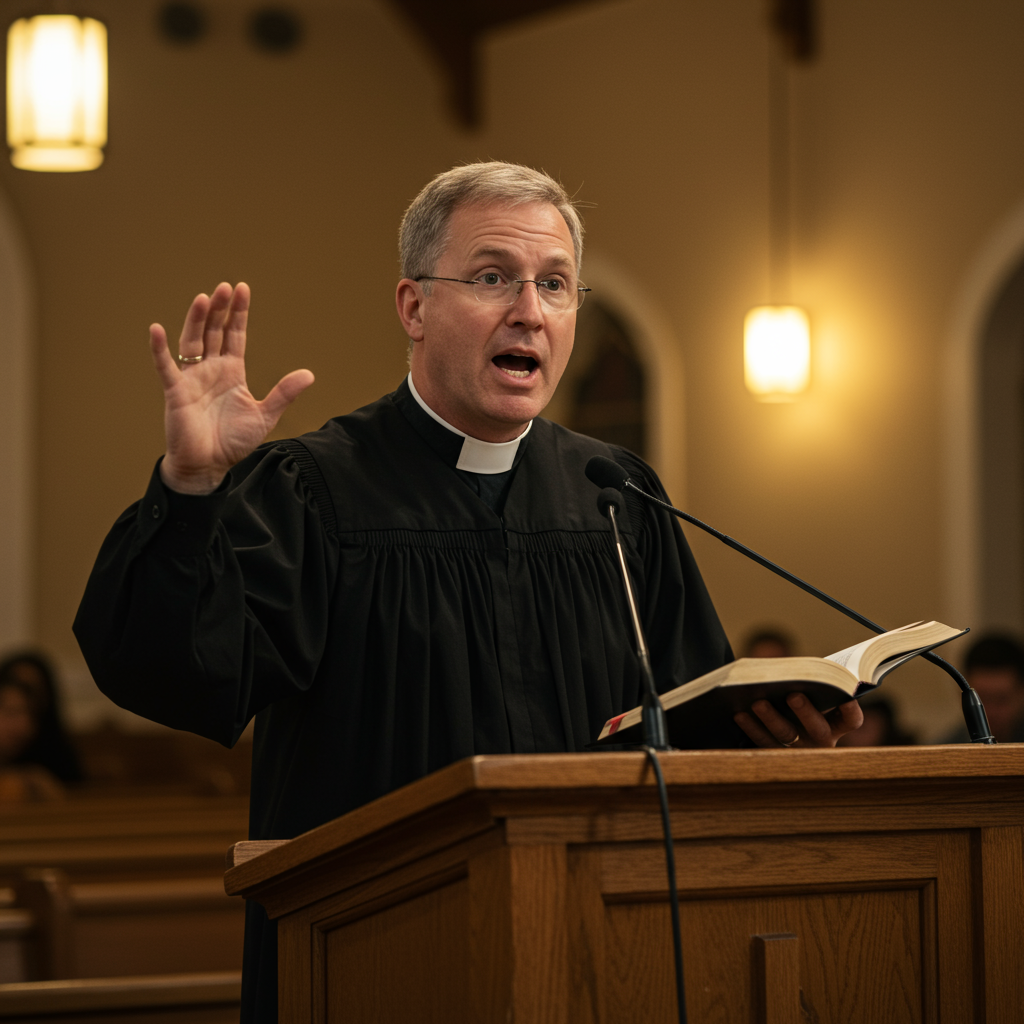
Paul and Silas do not sing because they feel free. Their backs are raw from the rods. Their feet are fastened in stocks. They have been misjudged, stripped, and thrown into the inner prison. If they wait for their emotions to lift before they worship, there will be no song. Instead, they choose worship as a way of locating themselves in a larger story than the one written by the magistrates. They sing to remember who holds the night.
💡 Pro Tip for Ministries and Nonprofits: Build rhythms of prayer and worship into your work that do not depend on visible outcomes. Midnight worship is formed long before midnight comes.
For communities and organizations, this has sharp edges. There will be seasons when funding is thin, when a program you love is cut, when a participant you have prayed for returns to old patterns, when the weight of the stories you carry feels unbearable. In those moments, worship is not about pretending things are fine. It is about refusing to let despair become your only counselor. It is about saying, with your schedule, your policies, and your posture, “We will not let the worst hour in the building decide who God is to us.”
Every Door Opened, Every Chain Loosed — and Nobody Walked Out
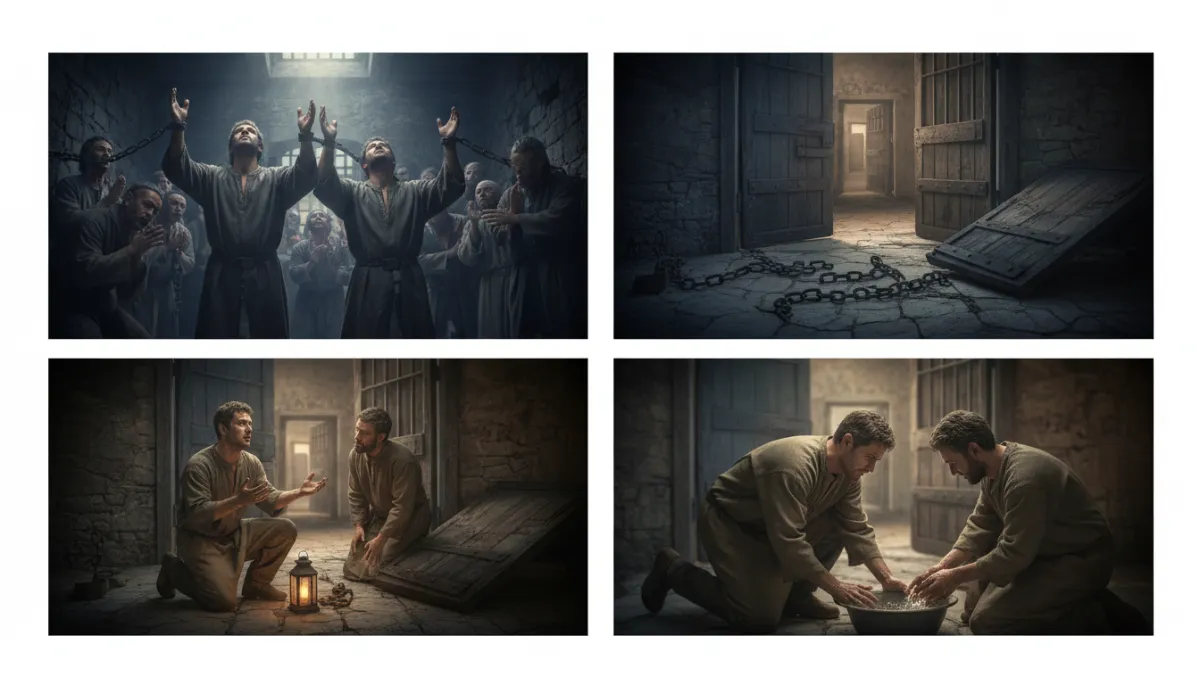
Then the earthquake comes. The foundations shake. Doors swing open. Chains fall off. It is the moment every incarcerated person dreams of and every system fears. In a purely human story, this is where the men run. But Acts 16 does something unsettling: no one leaves. The doors are open, the restraints are gone, and yet when the jailer rushes in, Paul can say, “Do not harm yourself, for we are all here.” (Acts 16:28).
What kind of freedom is this, that refuses to step over a man’s body to claim it? The earthquake delivers the possibility of escape, but the worship that preceded it has already redefined what freedom means. Freedom is no longer just the absence of bars; it is the presence of a different allegiance. The men have been listening. They have inhaled the sound of two wounded people trusting a God who is not intimidated by chains. When the doors fly open, they do not simply react to opportunity; they respond to a new center of gravity in the room.
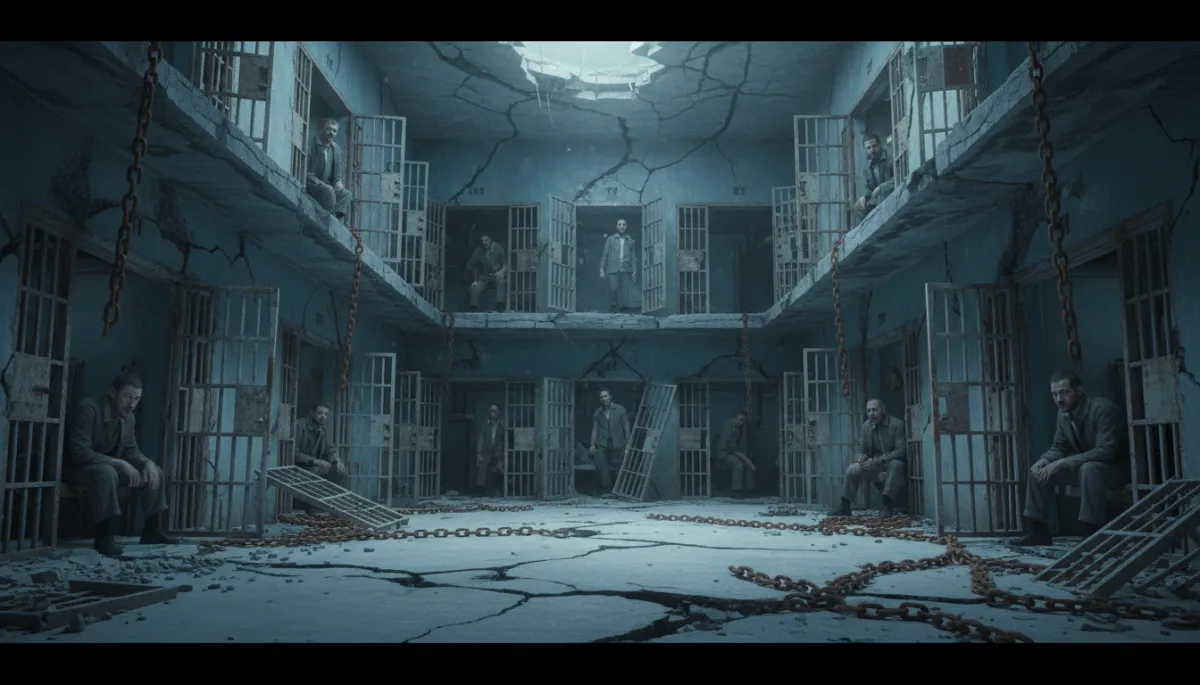
When freedom is redefined, open doors become places of discernment, not escape.
For ministries and nonprofits, this is a quiet but urgent warning. We often measure success by exits: who left the facility, who completed the program, who moved out of the shelter, who graduated from the class. But Acts 16 asks a harder question: What if real liberation is not just about people getting out, but about people becoming free enough not to abandon one another when the system starts to shake? In that cellblock, the miracle is not only that chains fall; it is that community holds. Nobody walks out, because the story is not finished, and the man who locked them in is about to discover that he, too, is imprisoned.
The Jailer: The System Man Who Ends Up Asking How to Be Saved
The jailer is not a villain in his own mind. He is a man doing his job, following orders, enforcing what has been handed to him. He secures Paul and Silas in the inner cell because that is what the paperwork requires. He goes to sleep assuming the story is predictable: the prisoners stay locked, he keeps his post, the system hums along. The earthquake interrupts not only the building but the script he has been given. When he wakes, sees the doors open, and assumes everyone has escaped, he draws his sword. Better to die by his own hand than to face the consequences of a system that only knows how to punish failure.
The cry comes from the dark: “Do not harm yourself, for we are all here.” In that moment, the jailer realizes that the men he thought he was guarding have chosen to guard him. The ones he assumed were the problem have become his protection. The system has trained him to see them as a threat; their worship has trained them to see him as a neighbor. That reversal undoes him. He calls for lights, rushes in, falls trembling before Paul and Silas, and asks the question that has been forming beneath his uniform: “Sirs, what must I do to be saved?”
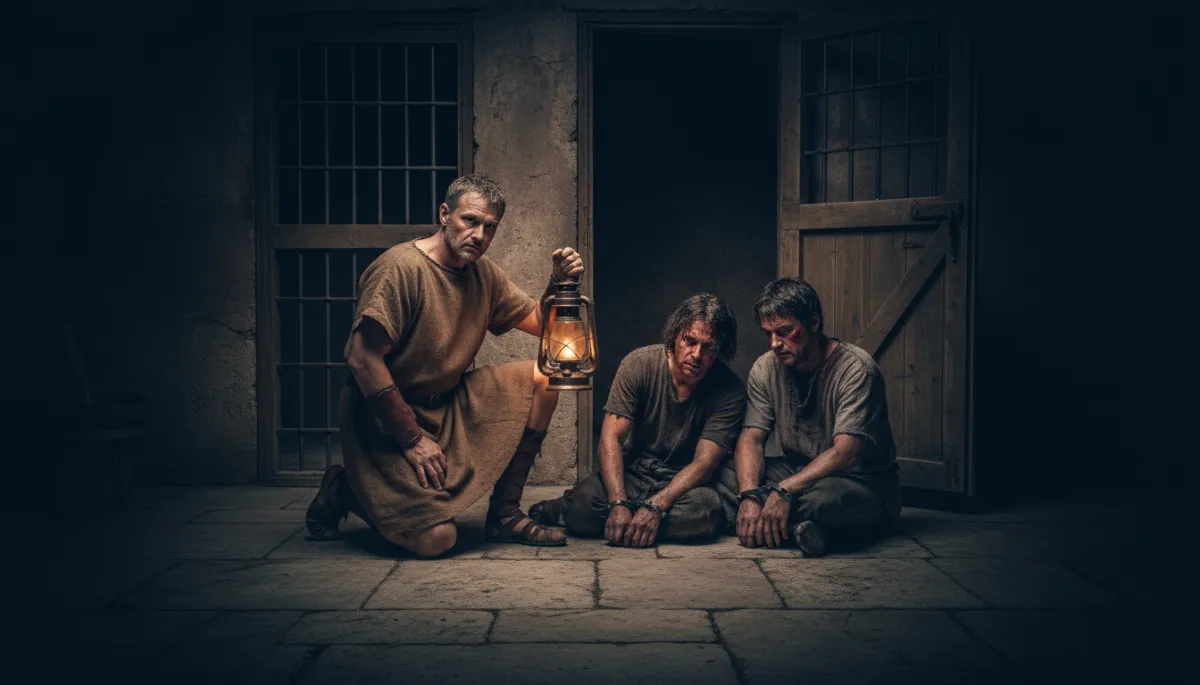
The man enforcing the system becomes the one who finally asks for rescue.
For nonprofits and ministries, this matters deeply. The “jailer” in your context may be a correctional officer, a caseworker, a probation officer, a landlord, a school administrator, a policy maker, a donor — people who feel trapped inside systems they did not design but now enforce. They are often exhausted, cynical, and quietly afraid. They rarely get asked how they are doing. Yet Acts 16 insists that the gospel is not only for the ones in the cells but also for the ones holding the keys. The routine man, the system woman, the one just doing their job, may be the person most ready to whisper, “What must I do to be saved?”
📌 Key Takeaway: Ministry Prayer Life has seen again and again that staff, officers, and volunteers call the prayer line not as professionals, but as people quietly asking the jailer’s question: Is there hope for me, too?
Washing the Wounds He Helped Inflict: The First Act of a New Faith
After the jailer hears the simple answer — “Believe in the Lord Jesus, and you will be saved, you and your household” — something shifts in him that cannot stay invisible. Acts 16:33 says, “And he took them the same hour of the night and washed their wounds.” The man who had locked them in now tends to the stripes on their backs. Before he feeds them, before he sleeps, before he returns to his routine, he kneels where the pain is and puts his hands into the consequences of his own participation in the system.
This is not sentiment. It is repentance with a basin. It is faith that moves directly toward repair. The jailer cannot change the beating that has already happened, but he can refuse to let the story end with untreated wounds. His first act of discipleship is not singing a hymn or attending a class; it is touching what he once ignored. He honors the bodies that the system had treated as expendable. He lets compassion interrupt his schedule, his role, his distance.
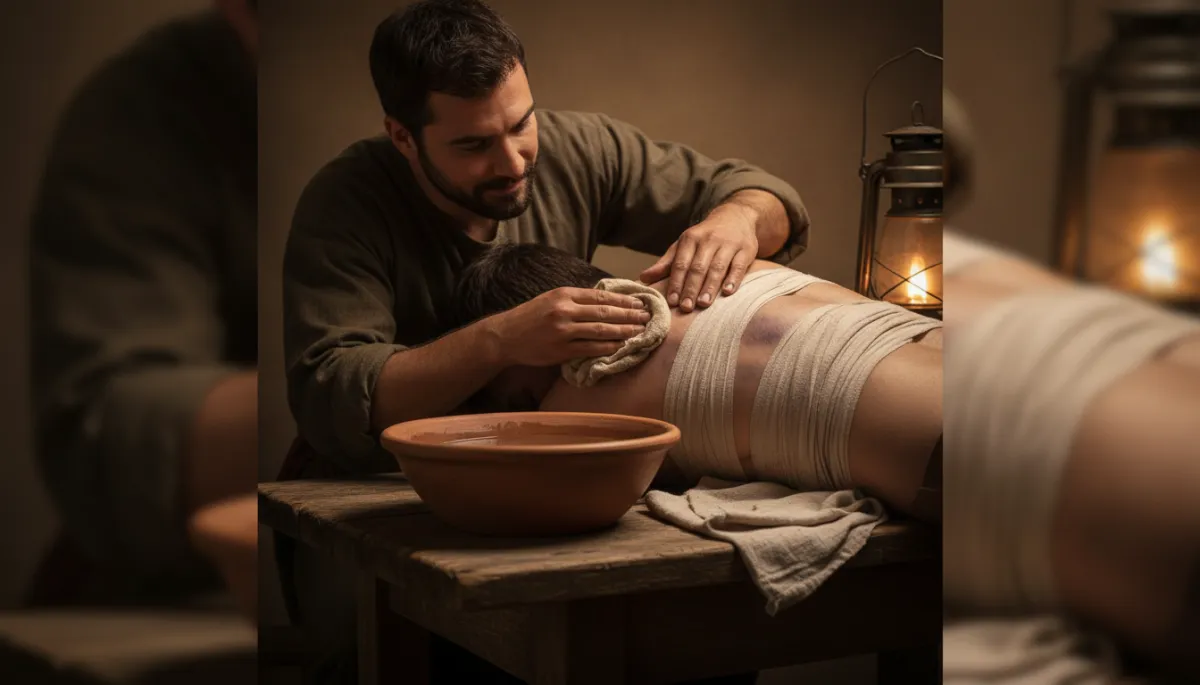
New faith bends low to wash wounds it once overlooked or helped create.
For nonprofits and communities, this is a picture of what transformation looks like when it begins to touch systems. New faith is not satisfied with new feelings; it moves toward the places where harm has been done. It asks, Whose wounds have we walked past? Whose pain has been the cost of our comfort or our efficiency? When a landlord reconsiders how they treat tenants, when a volunteer apologizes to a participant they once judged, when a policy maker listens to stories they previously dismissed, they are stepping into the jailer’s basin work. They are washing wounds in the same hour of the night, refusing to wait until morning to begin repair.
What This Midnight Story Asks of Nonprofits and Communities
Acts 16 will not let us stay at a safe distance. It invites organizations, churches, and ministries into a different way of measuring faithfulness. The question is not only, Did the earthquake come? but also:
Who is listening? Not just who attends your programs, but who overhears your conversations, your prayers, your decisions. What are they learning about God from the way you carry midnight?
Where have you believed in private witness? In facilities, shelters, and neighborhoods, your faith is already public. How might you live more intentionally, knowing that every hallway and waiting room is a sanctuary of sorts?
How do you practice midnight worship? What habits keep you rooted when outcomes are delayed, when grants fall through, when the people you love relapse or reoffend? Where do you choose worship when emotion is absent?
What will you do with open doors? When opportunities come, will you rush out alone, or will you stay long enough to make sure the jailer does not die by his own sword? How will you discern freedom that does not abandon those who are slower to move?
Who is your jailer? Which staff, officers, partners, or donors are quietly exhausted, standing guard over a system that is shaking? How might you become the voice in the dark that says, “Do not harm yourself; we are all here.”
Where are the wounds you need to wash? What relationships, communities, or policies bear the marks of your past indifference or complicity? What would it mean to bring water, cloth, and time to those places now?
Joining the Midnight Work: How Ministry Prayer Life Walks Into These Cells
The midnight in Acts 16 is not locked in the first century. It lives in county jails, state prisons, reentry houses, hospital rooms, motels, and quiet apartments where someone sits awake, counting the cost of their story. Ministry Prayer Life exists because midnight does not keep business hours. Our calling is to hold a line of prayer and pastoral presence that does not look away when the earthquake hasn’t come yet, when the doors are still closed, when the chains feel heavier than the promises.
For nonprofits and communities, partnering with a ministry like ours can mean that your staff, volunteers, participants, and even your “jailers” have somewhere to turn when their own midnight arrives. We listen for the questions beneath the job titles, the tremors beneath the routines. We pray with people who are still in the cell and with those who locked the door and then went home, carrying the weight of what they’ve seen. We believe that the same God who kept Paul and Silas singing can keep you steady when the tier is quiet and your heart is loud.
💬 A Word for You, If You’re at Midnight Right Now: You may feel like one more person doing their job, or one more person locked in a story you cannot change. But the listening has already begun. Your whispered prayer, your decision to keep showing up, your choice to sing in a cracked voice — it is echoing farther than you know.
A Quiet Invitation: Step Into the Story, Don’t Just Study It
Acts 16 does not ask for admiration; it asks for participation. It invites nonprofits to become communities where midnight worship is practiced, where listening is honored, where jailers are welcomed, and where wound-washing is considered normal Christian work. It invites volunteers and donors to see themselves not as spectators but as people whose choices about time, money, and presence can become part of someone else’s earthquake — or part of the quiet faithfulness that comes before it.
If your organization is weary, if your team feels like Paul and Silas in the inner cell, if your community is listening for a song they can trust, Ministry Prayer Life would be honored to stand with you. We cannot promise earthquakes. We can promise that you will not face midnight alone, and that your prayers will not fall into silence unnoticed. Somewhere, in the next cell over, someone is already listening.
Responding to the Midnight Call
If this midnight story is tugging at you — as a leader, a volunteer, a donor, or simply a person who recognizes yourself in either the prisoners or the jailer — you do not have to figure out the next step alone. You can reach out, in your own hour of the night, and find someone on the other end of the line who will listen, pray, and help you discern what wound-washing might look like where you are.
Call the 24/7 prayer line. Let someone hear your midnight and hold it with you. Submit a prayer request for your organization, your facility, your staff, or your own heart. Volunteer to be part of the quiet chorus that sings when others are too tired to lift their voices. Donate so that the line stays open for the next person who picks up a phone at 12:03 a.m., wondering if anyone will answer.
Somewhere tonight, in a cell or a small apartment or a worn-out office, someone is about to whisper, “What must I do to be saved?” May we be the kind of people, the kind of nonprofits, the kind of communities, who are still awake enough to answer.